The floor is already down, or it is staying. That fact should decide the wall color, because the floor is the largest fixed surface in the room and it sets the temperature everything else answers to. Most paint mistakes are not failures of taste but of sequence: a color chosen under shop lighting meets the floor for the first time on a Saturday morning, and by afternoon it is wrong.
Read the floor before you open the fan deck
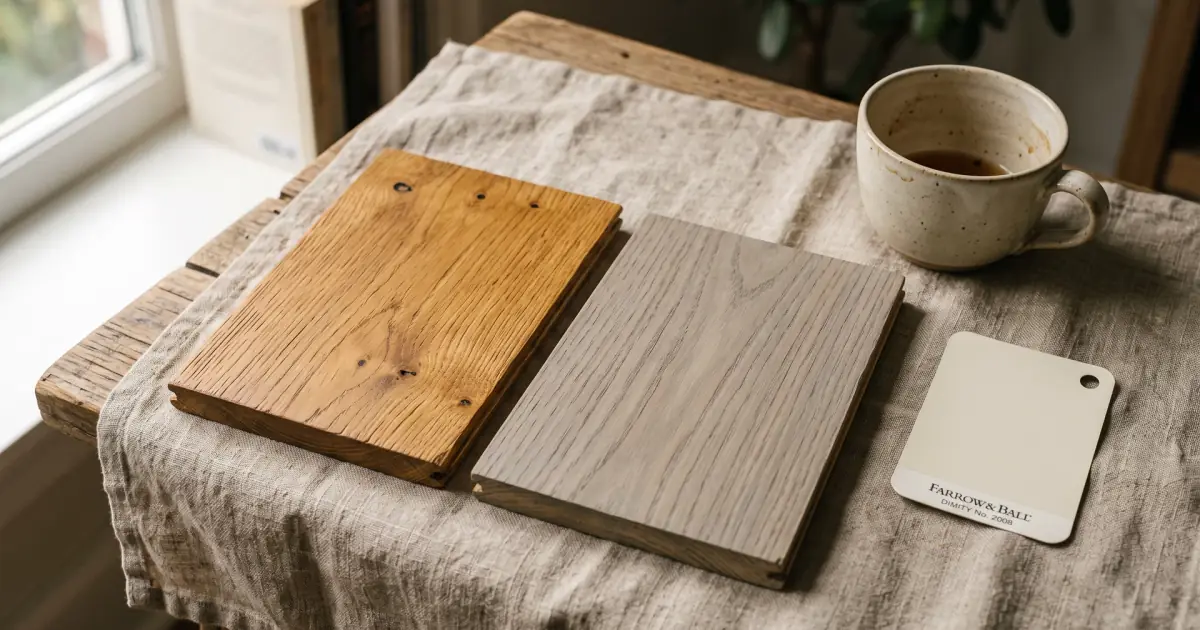
Start on your knees with the curtains open and a sheet of white paper in hand. Wood has an undertone, and it shows more clearly against white than against the wall you are about to replace. Pale oak reads yellow, gold, or faintly pink. Walnut reads red, orange, or a brown so deep it looks purple in the shadow of a table leg. Gray flooring reads blue, green, or brown, depending on how much pigment the finish carries.
Come back at dusk with the lamps on. This is the test most people skip and the one that matters. North light makes everything cooler; a warm bulb near 2700K swings the same boards toward amber. If a floor looks gray at noon and brown at eight in the evening, it will do that under paint too, and the wall has to survive both readings.
Measure the visible floor as well. With an 8×10 rug and a sectional, you may be painting to a border 18 inches wide, so compare samples there rather than at the middle of the room. The note on warm versus cool wood undertones explains why oak, ash, and maple drift differently under one light.
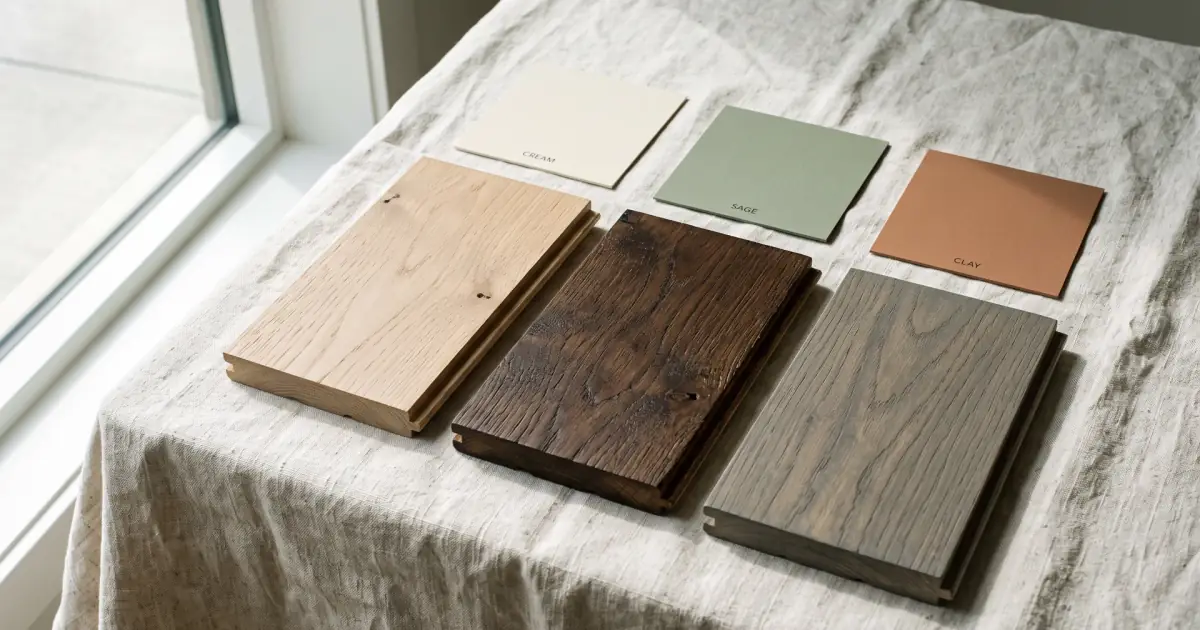
The three floor families
Nearly every wood floor belongs to one of three groups, each with a temperament you can learn in an hour.
Pale and medium oak
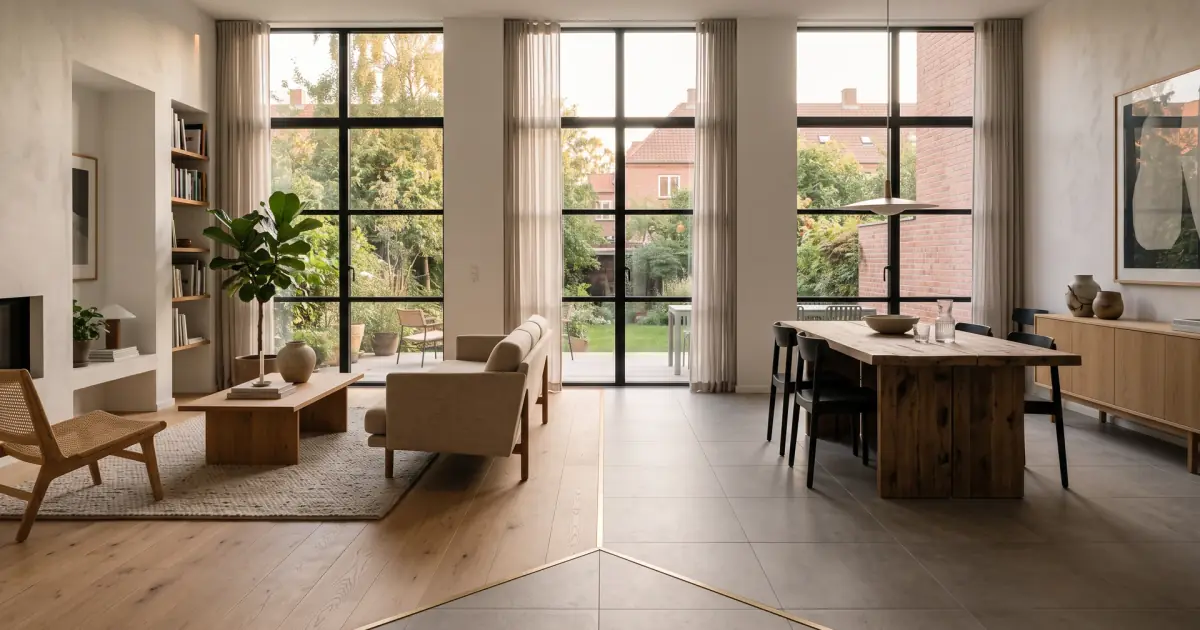
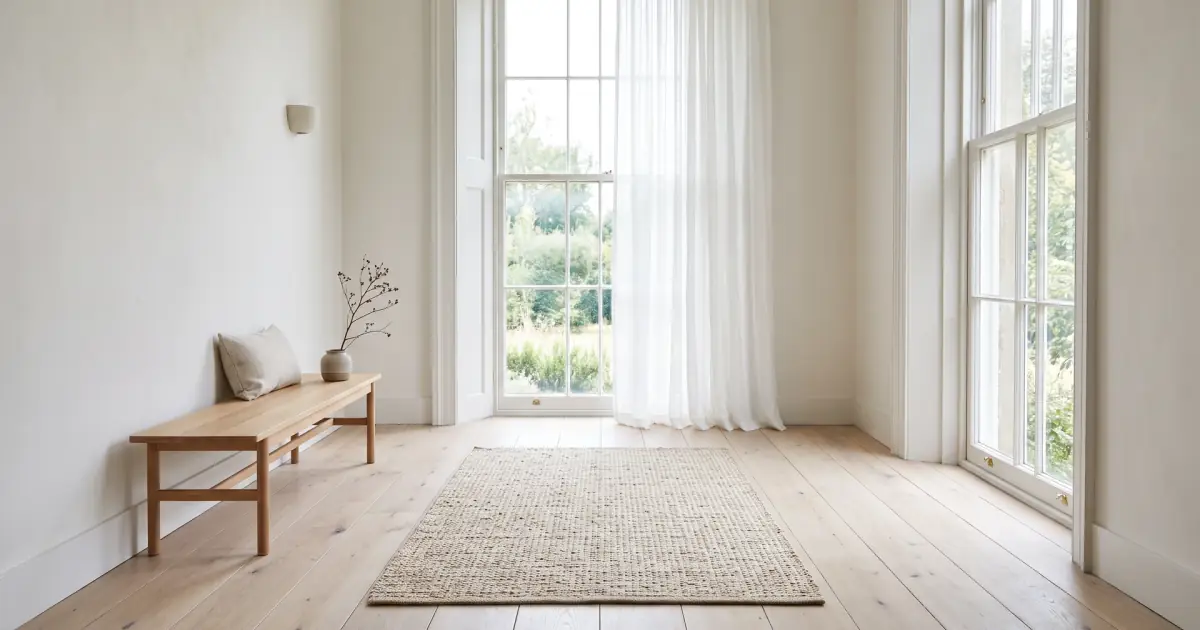
Oak is the easiest floor to paint against and the easiest to get wrong, because it is usually more yellow than people remember. The grain is busy, the surface is light, and it throws much of the light that reaches it back onto the wall. Warm whites, soft greiges, muted sages, and clay tones sit comfortably here; a Scandinavian room manages it with white walls, pale oak, and one dark object. Cool blue-grays are the risk, and the most common choice, which is why so many pale oak rooms feel slightly cold.
Red-brown walnut
Walnut is a saturated floor. It carries red and orange, sometimes a violet shadow in the grain, and it makes a room feel furnished before anything is moved in. It wants walls with warmth of their own: putty, bone, mushroom, deep olive, a green dark enough to read nearly black. Bright white on a blue base looks chalky beside it, and a very strong wall color competes with it for attention.
Cool gray
Gray flooring is a neutral with an opinion. It runs blue-gray, green-gray, or taupe, and it makes warm paint look warmer than the chip did. Cool whites and blue-grays are the safe pairing, and so are green-grays and soft charcoal. Yellow-beige is the trap, because beside a cool floor it can turn pink or dusty. The color pairings pages group combinations by family rather than by name.
Which wall family flatters which floor
Read the table as a starting point. The same paint behaves differently in a room with one window than in a room with four, so the last decision is always made on your wall.
| Floor family | Undertone in the floor | Walls that work | Walls to avoid | A reliable pairing |
|---|---|---|---|---|
| Pale and medium oak | yellow, gold, faint pink | warm white, greige, sage, clay | blue-gray, cool dove gray | Warm white walls with cream trim |
| Red-brown walnut | red, orange, violet shadow | putty, bone, mushroom, olive, charcoal | blue-white, icy gray | Mushroom walls with off-white trim |
| Cool gray | blue, green, taupe | cool white, blue-gray, green-gray, charcoal | yellow-beige, warm cream | Cool white walls with white trim |
Two things are worth noticing. No floor family wants a wall in its exact undertone; a near-match makes both surfaces look duller than they are. And every row has a warm and a cool option, so you are choosing a direction, not a correct answer. Where cabinets are a different wood from the floor, the wall often has to settle the argument, which is the subject of why floors and cabinets should not match.
Trim is a temperature control
Trim does more work than most people expect. A 5-inch baseboard in bright white makes a warm wall read warmer and a gray wall read cleaner. The same profile in cream softens the junction and makes oak feel less yellow. Trim color, more than wall color, is often what makes a room look finished.
Three approaches are reliable. Paint trim a shade or two lighter than the wall, in the same hue family, for a quiet room. Paint it bright white when the walls are mid-tone and you want definition at the floor line. Paint it the wall color when the room is small or the baseboard shallow: a 3-inch baseboard in the wall color disappears, while the same baseboard in white makes the gap between wall and wood look wider.
Three mismatches you can see coming
Yellow oak plus cool gray walls
This is the classic. A blue-based gray beside golden oak pulls the yellow out of the wood, and the wall turns faintly green in the corner where light is weakest. The effect is strongest in north-facing rooms and in the hour before sunset. If you want gray with oak, choose a greige with a hint of green or brown, and keep trim warm white.
Walnut plus bright white
Bright white needs light to stay white. Against a dark red-brown floor it loses that light and reads chalky, especially on a wall with no direct sun. The floor looks heavier, the wall looks thin, and the contrast becomes the only thing you notice. Off-white, bone, or soft putty keeps the contrast without the chalk.
Gray floor plus warm beige
Warm beige is usually mixed with yellow, and yellow beside a blue-gray floor turns peach. In a bedroom with a 9×12 rug you may see floor only at the perimeter, which makes the shift harder to diagnose. Test the beige at the baseboard, not at eye level.
Test with boards, not chips
Paint chips are too small to judge, and they are printed, not painted. Buy a sample pot and coat a 24-by-24-inch board, or a piece of foam board from an art shop, with two coats over primer. Make three if you are deciding between three colors. Move them around: one at the corner where wall meets floor, one beside the window, one opposite the main light.
Look at each board mid-morning, late afternoon, and after dark with the room lit as you use it. Write the time on the back with your reaction, because by the third day you will not remember which you liked at noon. Stand back six feet between readings. Paint is judged at distance, not at arm’s length.
When a color drench helps
Color drenching — walls, trim, ceiling, sometimes doors in one color — is the most useful tool for awkward geometry. A low ceiling, a soffit, a run of return walls, a radiator that cannot move: all stop being separate objects when painted the same value, and the eye goes to the floor.
It suits pale oak and a simple baseboard, and colors with depth: soft sage, warm gray, muted blue. It suits walnut least, where a dark floor and a dark drenched room collapse into each other, and rooms with one window. There, drench walls and ceiling but keep trim a half-step lighter.
A decision sequence for one afternoon
- At 11 a.m., lay white paper on the floor in three places and note the undertone each time.
- Measure the floor border around the largest rug.
- Pick two wall families from the table, one warm and one cool, and buy a sample pot of each.
- Paint two boards, two coats each, and label the backs.
- At 3 p.m., set both at the wall-floor junction, stand back six feet, and eliminate the one that goes green, chalky, or peach.
- At 8 p.m., with the lamps on, look again. If the survivor holds, buy it. If neither holds, move one step warmer and try a single board.
The sequence costs about four hours of elapsed time and forty minutes of work, which is less than repainting a room twice.
The short version
Choose the wall after the floor, and look at the floor in daylight and again at night. Match temperature to undertone without duplicating it: warm white and sage over pale oak, mushroom and olive over walnut, cool white and green-gray over gray flooring. Let trim do the fine-tuning, since a 5-inch baseboard changes how wide the floor line reads. Paint two large boards, live with them at the wall-floor junction for a day, and only then commit.
Three things to take away
Sample the wall color next to the floor at three times of day before committing.
Warm whites and sage flatter oak; cool whites make it look orange.
Use trim to control temperature, then keep it a step lighter than the wall.
Written by
More about the desk