Room study 05 · Slate tile
Entryway floors built for mud, grit and low light
Every visitor meets the entryway floor before they meet you. It is also the floor that takes the most grit, so choose for weather and then soften it.
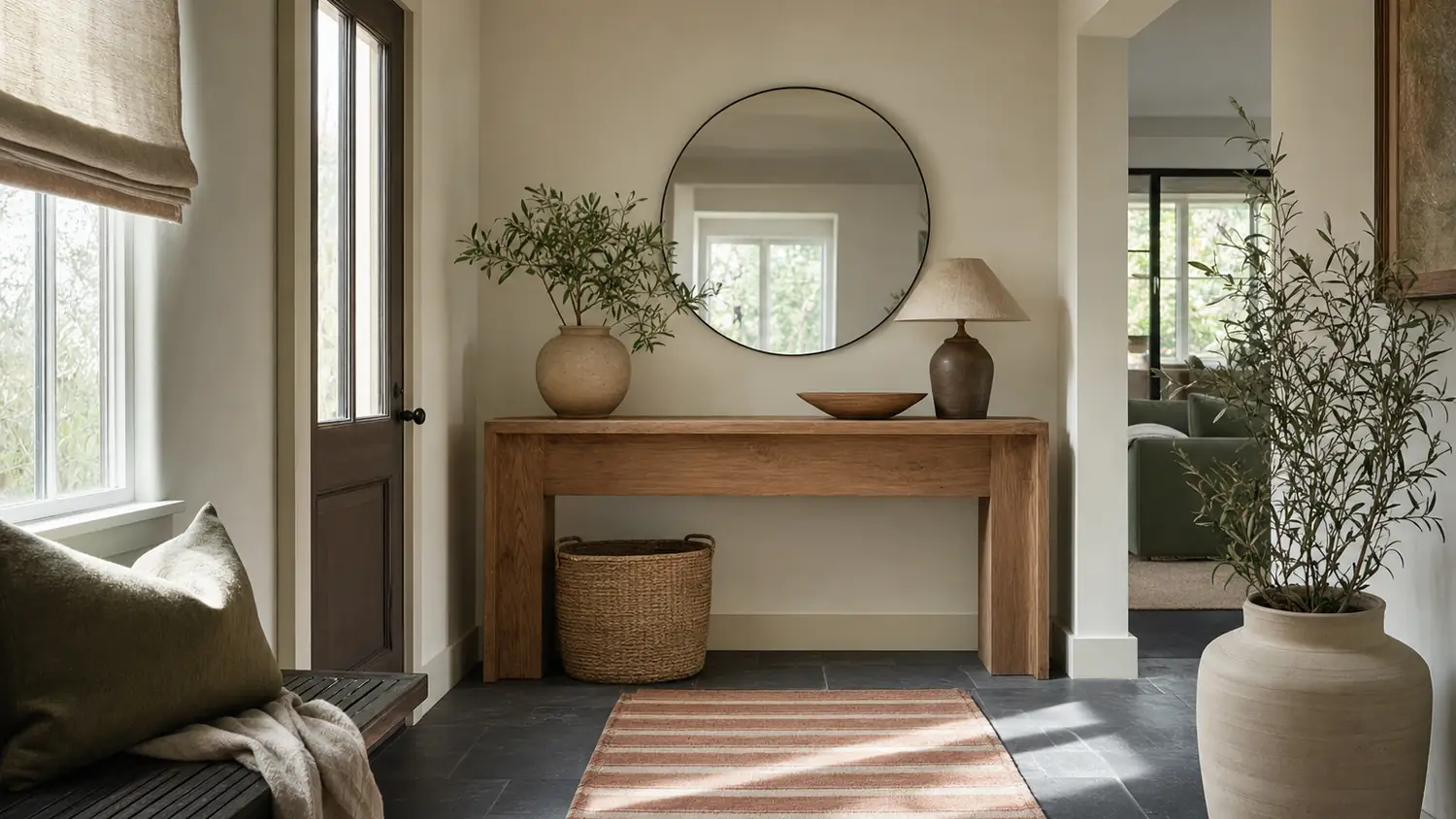
An entryway floor has a hard job. It meets wet boots, road salt, a bicycle wheel, a dog shaking itself dry, and the thirty-second scuff of a delivery driver. It is also the first thing a guest sees, which means it has to be tough without announcing how tough it is.
Hard, dark and forgiving
Slate is the classic entryway answer. It is dense, indifferent to water and naturally textured underfoot, and its color hides the grit that arrives with the first wet week of autumn. A dark gray or charcoal slate makes the threshold feel grounded and gives the rest of the house a soft landing.
Matte porcelain is the practical alternative: cheaper, more consistent, and available in a convincing slate look. Choose a tile with some texture rather than a polished surface; the entryway is exactly where a smooth tile becomes dangerous.
Wood is the warm option and works if the entry is covered and the household is diligent. Sealed engineered oak can handle an entryway, but a wet umbrella left against the wall will find the weak point. If in doubt, put hard flooring in the entry and let the wood begin one step inside.
Plan the dirt zone
The floor itself is only half the entryway. The other half is the place where wet things stop. A recessed mat well, a tray for boots, a basket for the dog towel: these are the details that determine whether the floor is still handsome in February.
A runner rug is the softening move. It absorbs water, catches grit and gives the hall a stripe of color. It should be washable or at least easy to vacuum, and it should stop short of the threshold so wet shoes meet hard floor first.
Light in a narrow hall
Entryways are often the darkest rooms in the house. A dark floor in a dark hall needs help: a pale wall, a mirror opposite the door, a lamp that stays on during the day. Without those, the room becomes a tunnel rather than a welcome.
If the hall gets no natural light, consider a mid-gray floor rather than near-black slate, and keep the walls pale and warm. The room will still feel grounded, but it will not feel like a cellar.
The transition inside
The change from entryway tile to living-room oak is the moment that tells a visitor they have arrived. Make it deliberate. A flush transition strip, the same color as the wood, keeps the change quiet; a metal profile reads as a clean architectural edge.
Where the floor levels differ, a step is safer than a ramp. Where they do not, keep the strip as thin as the materials allow. Our guide to open-plan transitions covers the details.
The palette
- Slate
- Oak
- Chalk
- Terracotta
Four floors, one room. The textures are sharpened samples rather than photographs, so you are reading color and grain, not the styling around them.
The room above is an illustration, not a photograph of a client's home. Colors will vary with your light; always choose from a physical sample.
A note
Everything in this study is a starting point. Your subfloor, your light and your household will edit it.