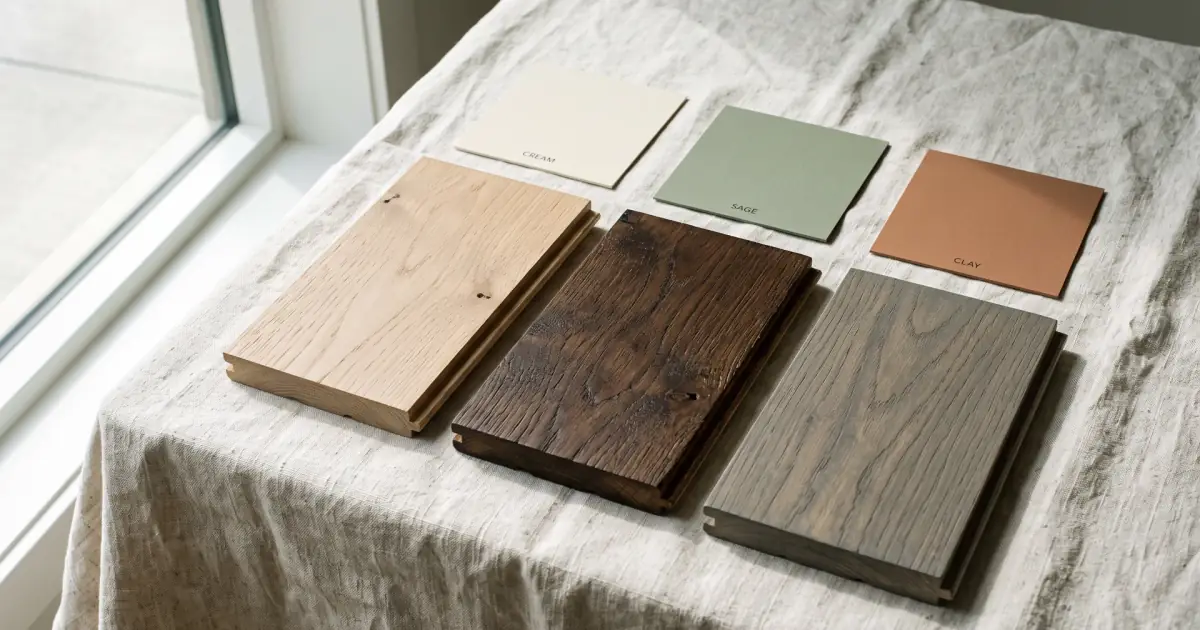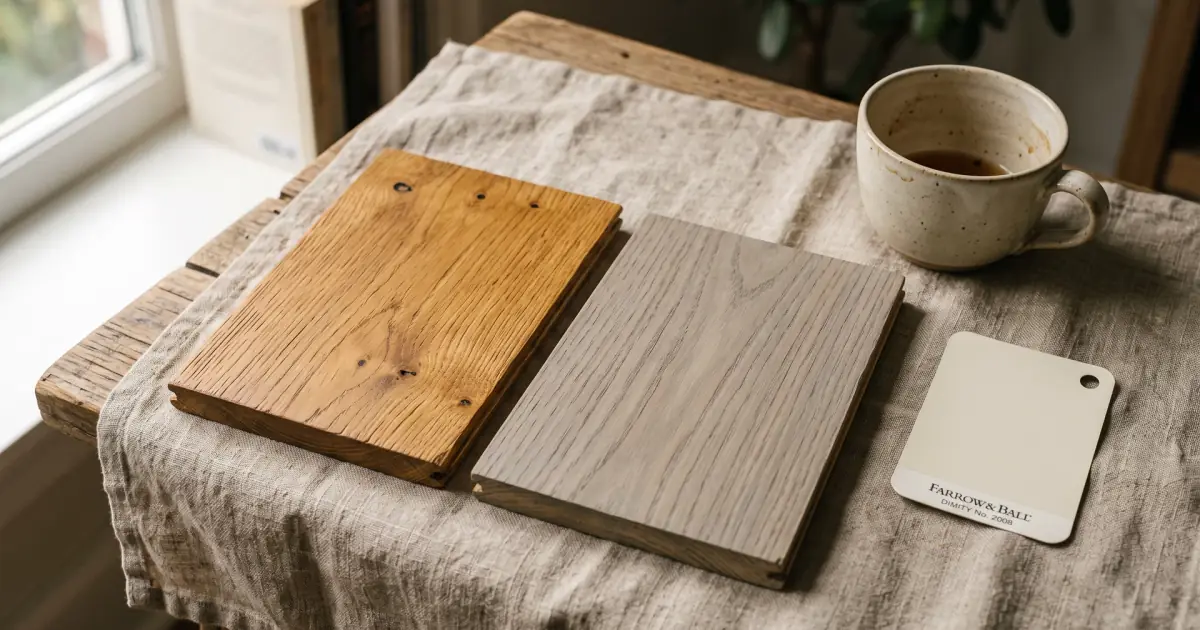
Two oak floors can sit in the same showroom, under the same light, and read as different materials. One is amber; the other is nearly gray. The difference is undertone — the base hue beneath the surface color — and it decides more about how a room feels than the paint on its walls does.
What undertone actually is
Surface color is what you name: oak, walnut, ash, natural. Undertone is what the name leaves out — the amber, the pink, the green-gray — and it is what the eye uses to decide whether two materials belong in the same room.
A floor’s cast comes from three layers: the species’ heartwood and sapwood, how the tree was cut and dried, and the finish sitting on top. Change any one and the surface color can stay roughly the same while the undertone moves a full step.
Warm: amber, red, honey
Warm floors carry an orange, red or yellow base: red oak, cherry, hickory, heart pine, and most white oak with an amber stain. They bring light into a north-facing room and make a space feel inhabited quickly. They also push everything near them: a warm floor makes a cool gray wall look blue and a white cabinet look cream.
Cool: ash, green-gray, taupe
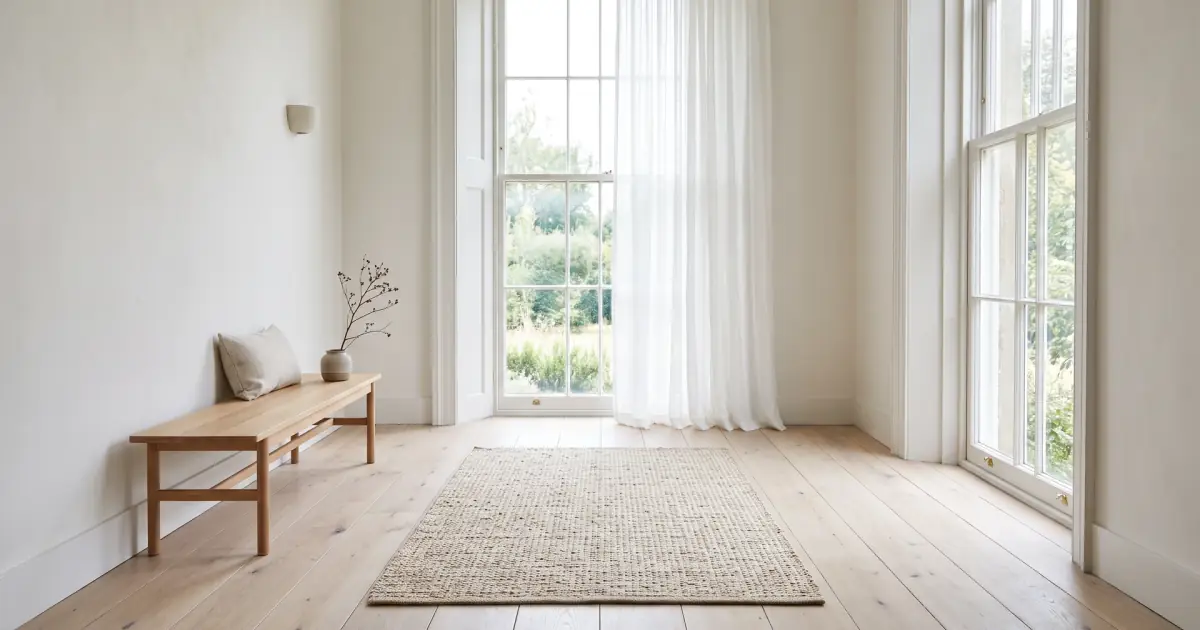
Cool floors carry a green, gray or blue base, or almost no hue at all. Ash, natural or fumed white oak, maple, some walnut — the palette behind most Scandinavian rooms. They recede. Color on the walls and cabinets stays where you put it, and a room with strong afternoon sun stays calm instead of turning amber at five o’clock.
Why the same oak can read either way
Oak is a genus, not a color. White oak and red oak are different species with different pore structure and different heartwood. Within white oak, the growing region, the age of the tree and the amount of sapwood in a given plank all shift the base hue. Then the mill sorts and grades, then the finish goes on.
A natural white oak in one showroom can be pale straw with a green cast; in another, honey with a pink edge. Neither is mislabeled. This is why ordering from a photograph is unreliable, and why an offcut from the actual lot matters more than any sample board.
What the finish does
Finish is the variable most often underestimated, because it changes the cast without changing the color name.
Oil, polyurethane, whitewash
Oil sits in the wood rather than on it. Pores stay open, grain stays legible, and the finish adds little color of its own; a hardwax oil deepens the wood by a shade and tends to preserve the undertone it found. Oil also oxidizes. A pale ash floor finished this way is subtly warmer at eighteen months than on the day it was laid.
Polyurethane builds a film. Water-based polyurethane stays clear and holds a cool or pale cast, which is how floors come to look almost bleached. Oil-modified polyurethane ambers, and on white oak it will pull a cool floor toward honey. Sheen matters as much as chemistry: matte reads as raw wood and lets the undertone through, while semi-gloss reflects the room’s colors back at you and muddies the reading.
Whitewash is pigment, not a clear coat. It sits in the grain, lowers the floor’s value and cools its cast, which is why it is the usual move when red oak needs to stop being pink. It will not hide the grain; on an open-pore oak it reads as a gray veil.
| Finish | Effect on the undertone | Reads best when |
|---|---|---|
| Hardwax oil | Keeps the wood’s own cast; ambers slightly over a year or two | You want the species to stay legible |
| Water-based polyurethane | Stays clear; holds a pale or cool cast | Pale ash and white oak in light-filled rooms |
| Oil-modified polyurethane | Adds amber; warms a cool floor by a step | Traditional rooms, pine, hickory |
| Whitewash or pigment | Cools and lowers value; a gray veil in the grain | Toning down red oak without hiding it |
Light direction and bulb temperature
A room’s light has two parts, and both move the floor’s apparent temperature.
Daylight first. A north-facing room receives cool, indirect light all day: warm floors look warmer in it, and cool floors can go flat. A south-facing room gets direct sun that runs warm at midday and warmer at the end of the afternoon; a cool floor balances that, while a warm floor under a July evening sun can read orange. East light is warm and brief, west light warm and long.
Then the bulbs. Most residential lighting lands between 2700K and 3000K. A 2700K lamp is noticeably amber and will make an oak floor warmer and a gray floor greige. A 3000K lamp is cleaner, holds a cool floor’s cast, and can leave a warm floor faintly yellow. Above 3500K, wood starts to look institutional. Kitchens often mix temperatures, a strip under the cabinets at one value and ceiling fixtures at another, which is why a floor can look right at the sink and wrong at the island.
Pairing rules: wall color, cabinetry, stone
Walls. A warm floor and a warm wall of similar value merge, so drop the wall two steps lighter or take it one darker and let the floor read as its own plane. A cool floor gives more room: it can carry a warm wall without a fight, which is why pale gray boards and soft clay walls make such an easy color pairing.
Cabinetry. A warm floor with white cabinets works if the white is clean rather than creamy; warm floor with cream is the pairing that most often reads dingy by afternoon. A cool floor with warm wood cabinets is one of the more reliable kitchen combinations, because the contrast is tonal rather than chromatic. There is more on this in the guide to wall paint with oak, walnut and gray floors.
Stone. Counters and splashes carry their own undertone, usually more saturated than the floor’s. Gray marble with a green cast beside warm oak pulls the oak toward yellow; cream stone beside cool ash makes the ash look blue. Carry the stone sample to the floor, not the other way around.
How to test a sample properly
Most sample failures are size failures. A 4-inch chip tells you the color; it does not tell you the temperature, because the eye needs area to judge a cast.
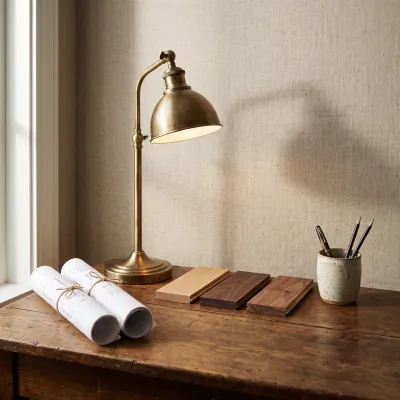
Get panels at least 12 by 18 inches, ideally 18 by 24, finished in the actual product. Lay them flat on the subfloor in two or three positions — by the window, mid-room, in the corner that never gets sun — and leave them for a full day. Look at 8 a.m., at noon and at 5 p.m.
Then do the north-south check: if the room faces north, carry one panel to a south-facing room and look again. A floor that is calm in bright light and gray in dim light is telling you something about the finish, not the color.
Finally, put the wall paint and a cabinet door down with the floor panel, all touching, and stand back 8 to 10 feet. Two materials can pass alone and fail in company.
When a cool floor is the calmer choice
Cool floors are not the cold choice; they are the quiet one. In a small room they recede and let the walls work, which is often what a tight plan needs. In a room full of wood furniture, gray or ash gives the pieces something to stand against instead of adding to the pile. In a south-facing room with strong light, a cool floor holds its color while a warm one changes hour by hour.
The exception is a room that is already cool: north-facing, one window, gray walls, gray light. A cool floor there leaves nothing to anchor the scheme, and a honey-toned oak will do more for the room than any careful neutral.
Moving between warm and cool without a seam
Two floor temperatures in one house are normal. The problem is the joint.
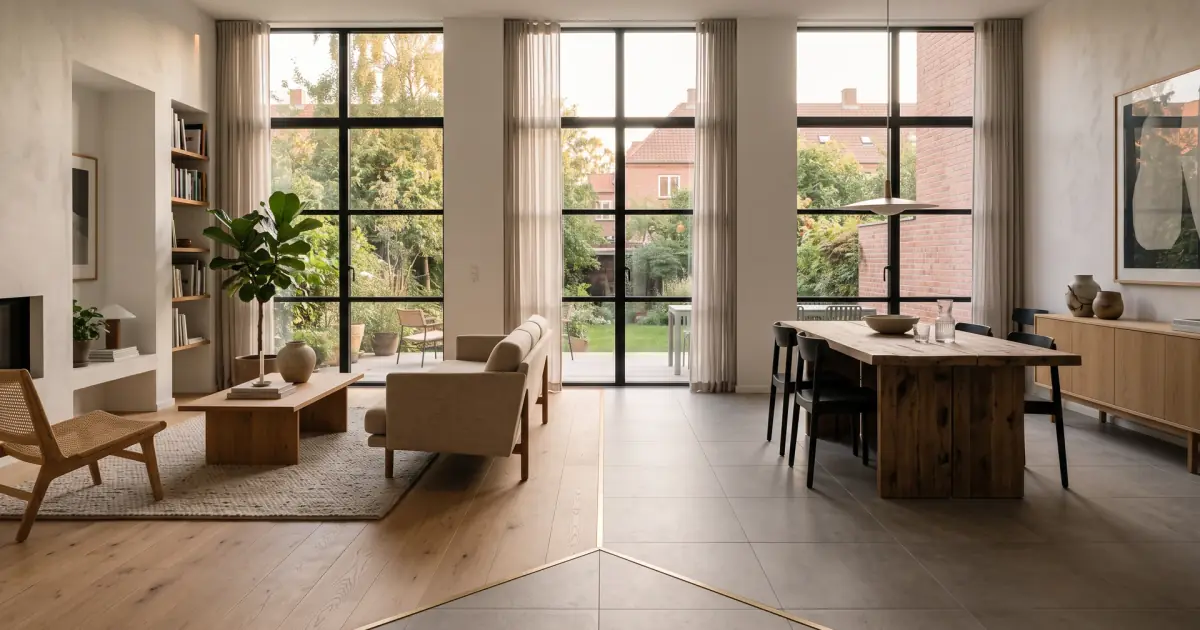
The most forgiving transition is a doorway with a cased opening: the casing gives the eye somewhere to stop, and the floors can meet under the door on a flat saddle. In an open plan with no door, the change should land on a full-height architectural line — the end of a wall, a dropped ceiling, the edge of a beam — rather than in the middle of a walkway. If no line exists, build one with a deliberate transition detail: a 4- to 6-inch board in a third tone laid across the opening, or a flush metal strip that reads as a threshold rather than a repair.
What fails is the diagonal seam, the zigzag, and the splice in the middle of a sight line. Keep the joint square to the direction of travel and full width, and two floors read as two rooms rather than one floor that ran out.
The short version
Undertone is the hue beneath the color, and it decides whether a floor and a cabinet belong together. Warm floors add light and push the colors around them; cool floors recede and hold their own. The same species can read either way, and the finish can move it a step in either direction. Judge samples at full size, in the room, through a full day of light, with the wall and cabinet beside them. Where temperature changes between rooms, let a doorway take the seam.
Three things to take away
Read the base hue, not the surface color: amber and red are warm, ash and green-gray are cool.
Finish and bulb temperature shift an undertone more than the species does.
When joining warm and cool floors, plan the transition instead of hiding it.
Written by
More about the desk